
Watson Joins Faculty to Translate Spatial Biology Techniques into Brain Cancer Treatments
By Toni Shears | January 9, 2026
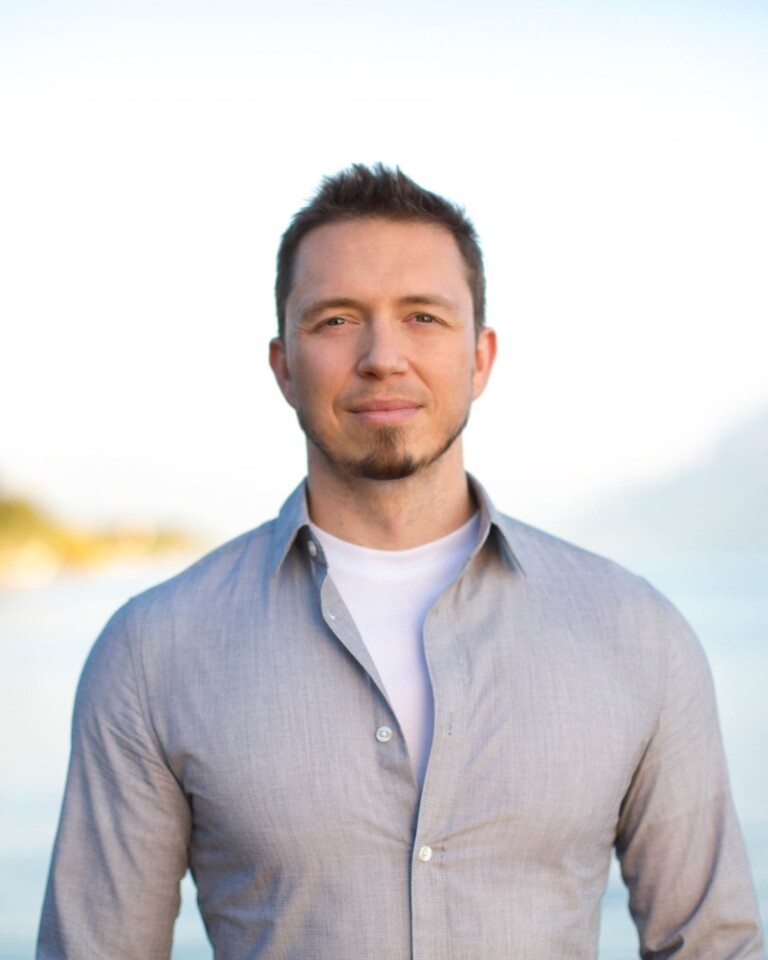
Researchers have had great success in spurring the immune system to battle cancers, but brain tumors have proven frustratingly resistant to immunotherapy. Glioblastomas, one of the most aggressive and lethal brain tumors, are especially good at evading treatment.
Spencer Watson, Assistant Professor of Pharmaceutical Sciences, the newest member of the College of Pharmacy faculty, may have pinpointed one reason why.
Watson, who specializes in tumor immunology, has used the techniques of spatial biology to learn how glioblastoma cells are evading treatment. This powerful new field uses several sophisticated technologies to reveal not only the components of tissues, but their physical location and how they interact with nearby molecules.
He has used spatial biology to show that treating tumors causes scarring in the brain. Glioblastoma cells hunker down and hide in this tangle of scars where treatment can’t reach them, then escape and seed new tumors months or years later, he says.
“Even your best immunotherapy treatment isn’t going to work if the immune cells can’t get next to the tumor cells,” explains Watson, who arrived at the College in January as an affiliated scholar, with his faculty appointment beginning in April.
Safe Havens for Tumor Cells
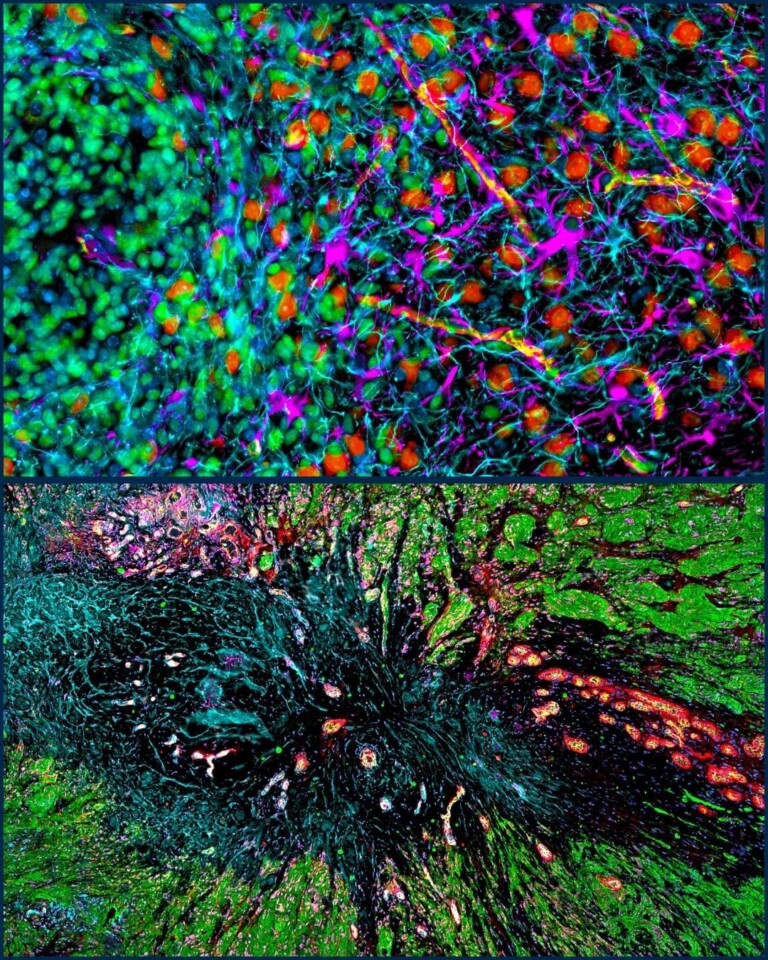
The treatment-induced scarring or fibrosis Watson has confirmed in glioblastoma cases occurs after treatments for many types of cancer. When this kind of scarring occurs in the brain after a concussion, it can be protective. When it results from cancer treatment, it creates safe havens where tumor cells can hide.
Spatial biology is a hybrid of biology, computational and imaging techniques that can reveal the structural relationships and interactions among molecules within tissues. Two- and three-dimensional imaging can reveal where the tumor cells are lurking. That makes it possible to engineer treatments that cut through the thicket of scars and attack them.
Watson’s research takes spatial biology a step further into mechanobiology. This means he not only maps the landscape of proteins within a tumor or tissue but also analyzes the mechanics of the structure holding the cells together.
“The cells are not just floating in some inert goo. They are embedded in a protein scaffold we call the extracellular matrix,” he explains. “With mechanobiology, we’re able to determine the hardness or the pliability of that extracellular matrix, and this can impact how the immune cells are able to attack the tumor.” Even the best immunotherapy treatments will not work if the immune cells can’t get through the matrix to get close to the malignancy, he notes.
Stop the Scarring
Because this scarring is a common side effect of many cancers, Watson sees even greater potential in trying to prevent the scarring altogether. His research team has developed a way to stop these cells from overreacting to chemotherapy.
“We are able to get a much more manageable wound healing response, and then you don’t get these giant scars that the tumor cells like to hide out in,” he says. By inhibiting the scarring, his team has doubled the effectiveness of an anti-cancer immunotherapy and virtually eliminated the tumors in animal models. This offers hope for improved treatment in human patients.
Mapping the Geography of Tumors
Watson believes spatial biology — named “technique of the year” by Nature in 2020 and again in 2024 — offers a way to make new inroads against intractable tumors that have stubbornly resisted even powerful new immune-based treatments.
For decades, the only way to analyze a specific tissue was “to dissolve it into a molecular soup,” Watson says. This method revealed the RNA, proteins, and metabolites that made up the tissue — but since you had lost the structure of the tissue, you had no information about how these molecules fit together or interacted. New spatial technologies now allow scientists to map the geography of molecules within the tissue, essentially creating high-resolution biological maps.
“It adds an entirely new dimension to biology,” Watson says. This is especially critical in cancer, because the location of cancer-causing cells determines whether immune cells or chemotherapies can even reach them.
From the Frontiers of Tumor Immunology to U-M
Watson is excited to bring his years of expertise and global collaborations on this new technology to the College.
After earning his PhD in bioengineering and cancer biology from Oregon State University in 2017 , he was recruited to join the lab of Joanna Joyce, an expert in the tumor microenvironment who is expanding the frontiers of tumor immunology in Lausanne, Switzerland.
He then became a senior fellow under Raphael Gottardo at CHUV (Lausanne University Hospital). “This field is very new, and to use these techniques, students need to develop expertise and skills drawn from multiple fields. They don’t really have the training for it,” he says. Watson helped Gottardo establish Europe’s first PhD program in spatial oncology. “I am excited to be bringing this expertise to pharmacy.”
“What drew me to the College of Pharmacy is the opportunity to translate these techniques into ways that we can start curing patients,” Watson said. “I’m excited about joining the growing spatial and single-cell research ecosystem at Michigan, to translate discoveries into real therapies.”
Ultimately, Watson sees the College of Pharmacy as the place where spatial biology can move from insight to impact. “It’s one thing to understand why a therapy fails,” he says. “It’s another to be in an environment where you can actually redesign it so that it works.”
________________
About the College
The University of Michigan College of Pharmacy has been leading at pharmacy’s edge for 150 years. The first and oldest pharmacy school at a state university, the College — currently ranked #2 in the nation — has and continues to shape education in the field. Its faculty are internationally recognized and are innovators in drug discovery, development and delivery, precision pharmacotherapy, outcomes research, and clinical practice. More than 5,000 alumni are enhancing patient care and outcomes from the bench to the bedside, in boardrooms and communities, government agencies, and within healthcare companies.
Latest News
University of Michigan Celebrates Grand Opening of New College of Pharmacy Building, Advancing the Future of Healthcare Education
August 28, 2026
Media Contact: Kylie Rydjord, Contact and Marketing Communications Manager, [email protected]
ANN ARBOR, Mich. — As part of its 150th anniversary celebration, the University of Michigan College of Pharmacy today celebrated the grand opening of its new six-floor, 142,000-square-foot building. A state-of-the-art facility designed to transform pharmacy education, research and collaboration for generations to come.
Nearly 700 alumni, […]
InterActions: A Lasting Reflection of Michigan Pharmacy
August 18, 2026
When the University of Michigan College of Pharmacy began designing its new home, every detail was considered with purpose — from innovative research spaces to collaborative areas where students, faculty, alumni and visitors could connect.
The building itself was envisioned as more than a place to learn and discover. It would also tell the story of […]
Ashley Kuzmik: Bridging the Gap Between Hospital and Home
August 10, 2026
For many families, the transition from hospital to home after a loved one with dementia is discharged can be overwhelming. New medications, changing symptoms, mobility challenges and the demands of caregiving often converge all at once, leaving families to navigate an already difficult journey. Helping make that transition easier is at the heart of Ashley […]