
Helpful Hitchhikers: Exploiting the Brain’s Pathways to Develop and Deliver Treatments
By Toni Shears | November 20, 2025
Millions of people worldwide suffer from neurodegenerative diseases like Alzheimer’s, Parkinson’s and amyotrophic lateral sclerosis (ALS) that damage neurons in the brain. The need for therapies that can repair the damage—or prevent it—is enormous.
Treatments developed so far have had limited benefits, and one of the reasons is that it’s difficult to get a therapeutic dose of drugs past the blood-brain barrier. That’s the challenge that drives the research of Peter Tessier, PhD, Albert M. Mattocks Professor of Pharmaceutical Sciences at the College of Pharmacy, who is also a Professor in Chemical Engineering at the College of Engineering. “We want to inject large molecules — proteins, peptides, nucleic acids — into the bloodstream and have them cross the blood-brain barrier in an efficient and predictable way to get them into the brain interior,” Tessier says.
One promising approach aims to exploit the brain’s existing mechanisms for selectively importing what it needs while excluding everything else. “Studying this, the first thing we realized is that the brain’s need for nutrients is huge, because it consumes so much energy for cellular functions and making proteins,” he notes. There are specialized receptors on the blood-brain barrier that bind with these essential nutrients and carry them into the brain. “We’re trying to design a molecule that can hitchhike on this normal pathway,” he says.
Hitchhiker Options: Transferrin Receptor or Amino Acid Transporters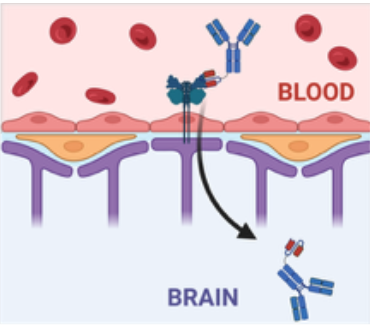
For example, the brain has a high demand for iron. A molecule found at the blood-bran barrier called a transferrin receptor binds with a protein called transferrin, which carries iron. The receptor shuttles the iron-bearing transferrin across the barrier and releases it into the brain. Tessier’s team is developing biologics that can bind to the transferrin receptor and stealthily ride along with it into the brain. “We’re trying to do it in a way so the cell doesn’t know and we won’t change the normal function of that transport pathway,” says Tessier. “We want the hitchhiker to be as undetectable as possible.”
Another possible vehicle for these helpful hitchhikers is amino acid transporters that are also found at the blood-brain barrier. These transporters shuttle in the large supply of amino acids the brain needs to generate the proteins it needs.
Tessier has identified interesting differences in the kinetics of the different iron and amino acid transporters he is studying. “The iron transporter is very fast, and in some cases, that’s the kind of pathway we want. In other cases, we want a slower, controlled, long-lasting delivery, so we want to use a different pathway. There are really interesting advantages to each of them, and we’re trying to match the transport pathways with our therapeutic objectives inside the brain.”
The Hitchhikers’ Job
In neurodegenerative diseases, proteins in the brain go awry and damage neurons. For example, in Alzheimer’s disease and ALS, abnormal proteins build up in fibrils or “clumps” known as plaques that interfere with brain function. Tessier’s aim is to develop antibodies or other compounds that, when smuggled into the brain, can bind with these fibrils and eliminate the plaque buildup, potentially reducing or reversing symptoms of these diseases. The first generation of these anti-fibril antibody therapies has been approved, ”but the problem is that they don’t use a hitchhiker transport mechanism, so they don’t get into the brain very well,” Tessier says. “The hope is that if we can improve delivery of these antibodies into the brain, you might have even better therapeutic activity and maybe even better safety.” Another exciting possibility is to develop a gene-targeted therapy that will block the production of the harmful proteins in the first place, he adds.
Interfering with Inflammation
It’s increasingly recognized that an overactive immune response can cause inflammation in the brain as it does elsewhere in the body, and this intensifies the damage in neurodegenerative diseases. Tessier is collaborating with a multidisciplinary team on efforts to combat brain inflammation.
“If you could reduce the level of neuroinflammation, you could potentially reduce the severity of these diseases. We’re trying to develop therapeutics that could go into the brain and block key cytokines (immune proteins) that can cause a lot of trouble,” he says. “A proven strategy outside the brain is to use biologics to bind them. It’s like a trap that blocks their function. We’re testing agents that have already been validated in our body, trying to deliver them into the brain to see if they can also be protective, again, hitchhiking along these natural pathways across the blood-brain barrier.”
The project, called Michigan Initiative for Neuroinflammation Defense via Microphysiological and Antibody-based Platforms (MINDMAP), is a collaboration with Colin Greineder and Ben Singer from the U-M Medical School and Aditya Raghunandan at the U-M Dearborn College of Engineering and Computer Science. In September they received a Boost grant from the U-M Bold Challenges initiative to support the work.
Designing antibodies, proteins, and other biologics with precise targeting to a specific receptor or gene, smuggling them into the brain — and doing it safely — is a huge, mind-boggling challenge. Tessier, who is also a Professor of Chemical Engineering in the College of Engineering, acknowledges that, even to him, it sometimes seems like science fiction.
Technology Speeding Discovery
The task is made possible by advanced computational methods and machine learning that vastly accelerate the process of molecule design. Using artificial intelligence and machine learning, they can create computational models that predict the binding of biologics to the human blood-brain barrier and ultimately the ability of these molecules to penetrate into the brain.
Tessier’s team — in partnership with Greineder, Singer, and Raghunandan — are using microfluidic methods that involve manipulating small volumes of liquid to pass through tiny channels to rapidly test the ability of their biologics to cross the blood-brain barrier in human cell-based models. With these methods, they can run animal and human models simultaneously rather than sequentially, accelerating the discovery process.
“We’re trying to solve hard problems where often our lead therapeutics are active in animal models, but need to be modified to make them suitable for use in humans. These computer-driven techniques help us reach the final answer we need faster with less experimentation and lower risk of failing in clinical trials,” Tessier says.
Most Recent Stories
Think Pharmacy Is Just for People? Think Again.
October 8, 2026
When Maddie Pislin first came to the University of Michigan College of Pharmacy, she knew she wanted to be a pharmacist. She just didn’t know yet what that could look like.
Growing up in Hawaii surrounded by dogs, chickens, a turtle and other pets, Maddie had considered becoming a veterinarian. But veterinary pharmacy wasn’t on her […]
Pharmacists Are Like Superheroes: Who is a Pharmacist?
September 23, 2026
Who Is A Pharmacist?
When you think “pharmacist,” you probably picture someone in a white coat, handing you a bag of medicine across the counter and asking if you have any questions about your prescription. We are so lucky to have access to these health care providers on a regular basis, especially after hours when our […]
Jennifer Hagopian on Curiosity, Mentorship and Transplant Pharmacy
August 19, 2026
When Jennifer (Jen) Hagopian, PharmD, BCPS, BCTXP, selected a solid organ transplant APPE as a pharmacy student, she wasn’t planning her future career. She simply wanted to explore an area she didn’t know much about. That one rotation changed everything.
“I just tried to pick things that I didn’t really know too much about,” Dr. Hagopian […]