
Engineering Enhanced Payloads for Cancer-Fighting Antibodies
August 8, 2024
By: Toni Shears
 Some of our most promising new therapies in the fight against cancer and other diseases leverage the benefits of antibodies, which are one of the workhorses of the normal immune system.
Antibodies can be engineered to locate and bind to any target in the body with high specificity. They can find specific proteins or antigens associated with tumor cells and deliver therapeutic agents that degrade or kill the cells, shrinking tumors or suppressing their growth.
Just as naturally occurring antibodies linger in the body to provide a sustained immune response against an infectious agent, antibody therapies have long half-lives in the body, offering long-lasting and convenient dosing.
“Another great thing about antibodies is they are biologically based and in most cases are slowly cleared from the body by metabolic processes resulting in a fairly predictable trajectory as they move through the body.” says Brandon Bordeau, PhD, an Assistant Professor of Pharmaceutical Sciences.
Despite all these benefits, antibody-based therapies have some challenges. They can fail to hit the desired target and bind to normal healthy cells — or when antibodies are used to deliver chemotherapeutics the therapeutic payload can detach and end up elsewhere in the body. Both problems increase the toxicity and decrease the effectiveness of antibody-based drugs.
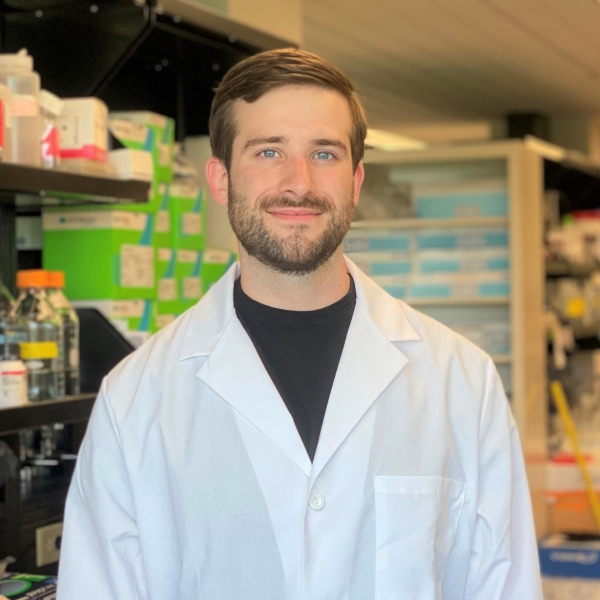
Dr. Bordeau, who joined the College faculty in December 2023 from the University of Buffalo, is working to overcome the known issues of antibody delivery. “My research focuses on how to optimize the use of antibodies to deliver drugs by engineering new antibody based therapies based on predictions that are made using pharmacokinetic modeling and simulation” he says.
One promising approach has been to pair a monoclonal antibody to a small-molecule drug with a chemical linker. Called antibody-drug conjugates (ADCs), these molecules have shown promise in delivering cell-killing drugs directly to a tumor. The FDA has approved about a dozen ADCs for clinical use. While they have been effective for some patients, this class of drugs has limitations due to excess toxicity. In previous work with his Buffalo colleagues, Dr. Bordeau explored the mechanisms behind ADC toxicity and strategies to enhance their effectiveness.
At the College of Pharmacy, a new focus of his work explores unique payloads that can disrupt the function or replication of malignant cells. One promising approach is using antibodies to deliver proteolysis-targeting chimeras, or PROTACS. PROTACs are designed to degrade pathogenic proteins associated with tumor growth.
Developing better ways to bind the payload to the antibody is another goal. When the drug stays attached and reliably reaches the target cells, it’s possible to reduce the drug payload, yet increase the antibody dosage without greater toxicity. In some cases, a small change to the payload has greatly increased a drug’s tumor-fighting effectiveness, Dr. Bordeau says. And if the payload is successfully delivered and can move around inside the tumor, it can attack cells the antibody did not bind to, in a “bystander effect” that bolsters the tumor-fighting impact.
The use of antibodies to treat cancer and other diseases has been growing over the last 20 years. Many drugs have proved effective at destroying cancer cells and shrinking tumors or slowing their growth. These advances are bringing hope and improved survival rates to cancer patients.
Still, the effectiveness of antibody therapies can vary among patients depending on age, the patient’s immune response, how well the target is expressed, and other factors. Dr. Bordeau sees room on the horizon to continue to enhance the effectiveness and safety of these therapies with more precise targeting and improved payloads. “There is plenty of opportunity to improve what we can do in the fight against cancer and apply the power of antibodies to new disease states,” he says.
We are excited to follow Dr. Bordeau and his drug delivery research and continue to make the impacts that pharmacy has had for centuries, make safe, efficacious therapies to improve health outcomes, and hopefully eradicate cancer in our lifetime.
Most Recent Stories
Think Pharmacy Is Just for People? Think Again.
October 8, 2026
When Maddie Pislin first came to the University of Michigan College of Pharmacy, she knew she wanted to be a pharmacist. She just didn’t know yet what that could look like.
Growing up in Hawaii surrounded by dogs, chickens, a turtle and other pets, Maddie had considered becoming a veterinarian. But veterinary pharmacy wasn’t on her […]
Pharmacists Are Like Superheroes: Who is a Pharmacist?
September 23, 2026
Who Is A Pharmacist?
When you think “pharmacist,” you probably picture someone in a white coat, handing you a bag of medicine across the counter and asking if you have any questions about your prescription. We are so lucky to have access to these health care providers on a regular basis, especially after hours when our […]
Jennifer Hagopian on Curiosity, Mentorship and Transplant Pharmacy
August 19, 2026
When Jennifer (Jen) Hagopian, PharmD, BCPS, BCTXP, selected a solid organ transplant APPE as a pharmacy student, she wasn’t planning her future career. She simply wanted to explore an area she didn’t know much about. That one rotation changed everything.
“I just tried to pick things that I didn’t really know too much about,” Dr. Hagopian […]