
Pharmacists Bridging the Disparity Gap in Blood Pressure Control
December 10, 2024
By: Markie Heideman, Content Marketing Manager
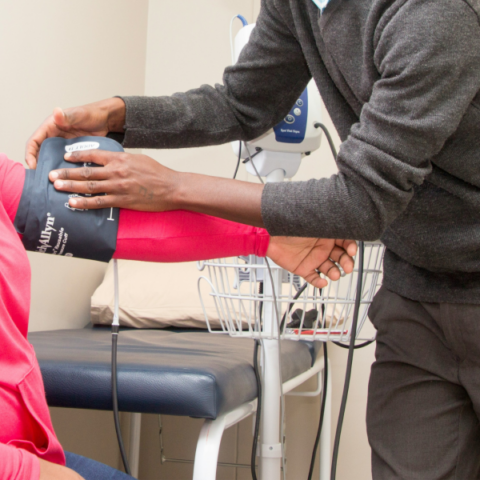 Across the country, patients facing chronic conditions like hypertension (or high blood pressure) are experiencing high wait times and limited availability to see their primary care doctors – due to a shortage of providers. To help alleviate this congestion, clinical pharmacists are stepping up to the plate.
“Healthcare access is currently a significant challenge, and embedded pharmacists present an innovative way to leverage existing community resources to better support patients.,” explained Dr. Amy Thompson.
Thompson wears many hats at U-M – from Clinical Professor of Pharmacy and Director of Community Health and Engagement for the College of Pharmacy to Director of Population Health Pharmacy and Community Partnerships, Pharmacy Innovations and Partnerships at Michigan Medicine. She helps spearhead the Hypertension Pharmacists Program developed by College of Pharmacy Associate Dean Hae Mi Choe.
The program embeds pharmacists as a part of the healthcare team in Michigan Medicine primary care clinics and community pharmacies to help monitor and control blood pressure in patients. The program is so successful that it was adopted by the CDC earlier this year.
Closing the Gap in Blood Pressure Control for Black Populations
In an effort to close the disparity gap in blood pressure control between Black and Caucasian patients, blood pressure cuffs were provided to patients in need at two Michigan Medicine primary care clinics.
“Using our quality data, we decided to start our intervention at the two primary care clinics with the largest denominator of Black patients. Unfortunately, in accordance with our disparity data, these were also the two primary clinics with the poorest blood pressure control for our Black patient population,” states Amy Vereecke, senior project manager within Pharmacy Innovations and Partnerships.
Over the course of a year, more than 126 blood pressure cuffs were distributed. Results from initial program evaluation showed that this program was instrumental in increasing blood pressure control among the Black population at these two sites. Patients were encouraged to share their home blood pressure readings with their healthcare team on a regular basis to track their progress). Pharmacy students also reached out to help patients track their readings and set up follow-up appointments with their pharmacist or primary care physician if needed.
“By having the help of a pharmacist, these patients were able to regularly consult with a healthcare provider to provide recommendations to improve their blood pressure control through changes in their lifestyle and medication,” explained Thompson.
Encouraging Results
By closely monitoring the blood pressure readings of this population and providing regular consultation, the average systolic and diastolic blood pressure readings decreased.
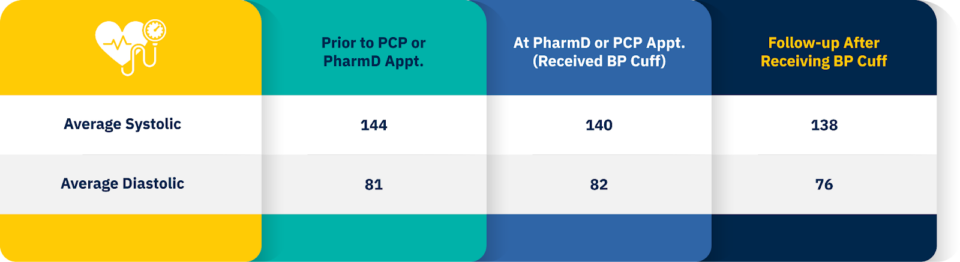
“We use the HEDIS measure of a blood pressure below 140/90 as a marker to determine if a patient’s blood pressure is under control. Among the population provided with blood pressure cuffs, we observed improvement, achieving levels below this target.”
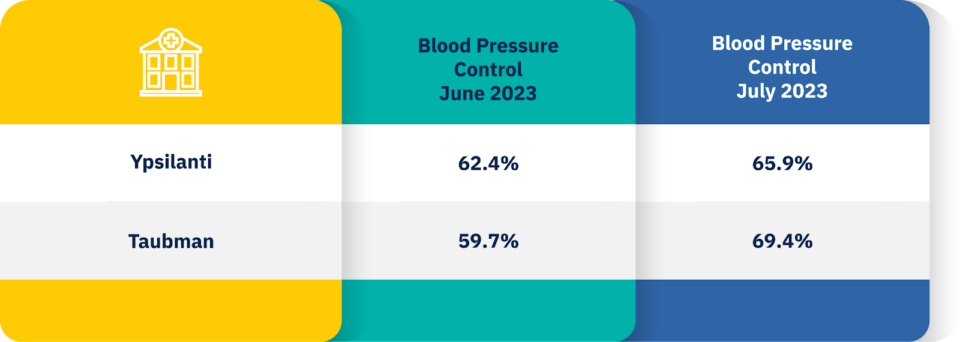
The average blood pressure control rate improved among Black patients at both clinics.
Looking Ahead
Outside of these two clinics, the team is working with ten additional Michigan Medicine clinics to meet or exceed 75% average blood pressure control for Black patients as of July 2024.
For Thompson and Vereecke, these results continue to prove that pharmacists have a future in helping an overwhelmed healthcare system treat the most vulnerable.
“Pharmacists are the most accessible healthcare provider. 95% of Americans live within five miles of a community pharmacy – we are right in their neighborhood. By equipping pharmacists with the resources to help patients with chronic conditions, we can help health outcomes on a broad scale.”
Each of Michigan Medicine’s primary care clinics has an embedded pharmacist on staff, but Dr. Thompson hopes to expand this specific study to all primary care and select specialty care locations to help bridge the gap in this health disparity – and they believe the program will be welcomed with open arms.
“We have surveyed providers in our clinics to gather their perspectives on embedded pharmacists and consistently received overwhelmingly positive feedback.”
Examples like this program show the important role that pharmacists can play as part of the care team to help improve patient care outcomes.
Most Recent Stories
Pharmacists Are Like Superheroes: Who is a Pharmacist?
September 23, 2026
Who Is A Pharmacist?
When you think “pharmacist,” you probably picture someone in a white coat, handing you a bag of medicine across the counter and asking if you have any questions about your prescription. We are so lucky to have access to these health care providers on a regular basis, especially after hours when our […]
Jennifer Hagopian on Curiosity, Mentorship and Transplant Pharmacy
August 19, 2026
When Jennifer (Jen) Hagopian, PharmD, BCPS, BCTXP, selected a solid organ transplant APPE as a pharmacy student, she wasn’t planning her future career. She simply wanted to explore an area she didn’t know much about. That one rotation changed everything.
“I just tried to pick things that I didn’t really know too much about,” Dr. Hagopian […]
InterActions: A Lasting Reflection of Michigan Pharmacy
August 18, 2026
When the University of Michigan College of Pharmacy began designing its new home, every detail was considered with purpose — from innovative research spaces to collaborative areas where students, faculty, alumni and visitors could connect.
The building itself was envisioned as more than a place to learn and discover. It would also tell the story of […]