
Sharma’s Mission: Precision Drug Development to Meet Unmet Needs
June 15, 2026
Rare eye conditions that slowly destroy vision. Brain injuries and degenerative neurological diseases beyond the reach of many drugs. These are some of the disease areas that Anjali Sharma, PhD, will target with her drug delivery research when she joins the College of Pharmacy Department of Pharmaceutical Sciences as an Associate Professor with tenure in July 2026.
Sharma develops nanoparticles custom-designed to deliver drugs directly to diseased or damaged cells or tissues while sparing healthy tissues. Her goal: developing next-generation nanomedicines to address unmet medical needs. “Whatever the disease, where there is no cure, that’s what I would like to work on,” says Sharma.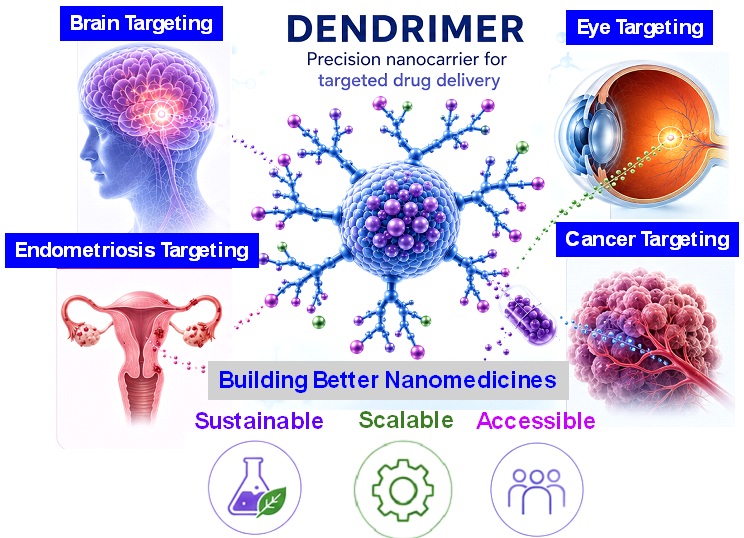
Working at the intersection of chemistry, biology, engineering, and nanotechnology, Sharma develops dendrimers, a type of polymer, to build nanocarriers precisely engineered for specific diseases. “These tiny carriers are like an Uber,” Sharma explains. “We attach targeting ligands, which are like the GPS. They deliver the dendrimers to their target destination. The drug is the passenger. At the destination, the drug molecules get out and enter the disease cells, and then the dendrimers leave the body.”
At a time when advanced nanomedicines are often criticized for being expensive, complex, and difficult to manufacture at scale, Sharma is working to redefine how next-generation nanomaterials are designed and produced. “Traditional dendrimer and polymer synthesis methods frequently require labor-intensive, multi-step processes and large amounts of costly reagents. This creates significant barriers to affordability and widespread clinical translation,” she said.
”Driven by a vision of sustainable and accessible healthcare, we are leveraging highly accelerated chemical transformations to pioneer a new generation of nanomaterials built from inexpensive, biocompatible, and Generally Recognized As Safe (GRAS) building blocks.”
Ultimately, her vision extends far beyond the laboratory bench. By creating clinically translatable nanomedicines that are simpler and more economical to manufacture, Sharma aims to help expand access to advanced therapies and diagnostics. “Our goal is to reduce the cost and burden of synthesizing these particles, while increasing the reproducibility and the scalability of these materials, so that it’s not ending up as a million-dollar medicine. If the therapy is successful, it should be available to all, ensuring that cutting-edge healthcare technologies can reach patients more broadly and equitably across the world.”
A Disease-first Approach
Dendrimers are ideal for Sharma’s purposes because they are highly structured, with a single molecular weight and multiple surface functionalities where useful molecules can be attached. “That gives you a lot of control in synthesizing them,” she says.
She builds in targeting, tracing, and treatment functionalities in one step while creating the dendrimer. “You can attach dye to the molecules to image where they are going. You can attach targeting ligands to target specific cell sites, and you can add a drug.”
Nanoparticles are an area of intense research as drug delivery vehicles and can now be purchased ready-made. Instead, Sharma takes a “disease-directed” approach, designing each dendrimer “from scratch”. “Each dendrimer we make is a new technology for a specific disease,” she says.
At her previous lab at Washington State University, her team developed a new 2-deoxyglucose dendrimer (2DG-D) technology designed to cross the blood-brain barrier and target disease-associated neurons. In a 2025 paper, Sharma and coauthors showed this approach has promise for treating pediatric traumatic brain injury.
She then developed a trehalose-based dendrimer to treat eye diseases that cause excess growth of blood vessels in the cornea or retina. In animal models, these drug-carrying dendrimers have been shown to completely clear blood vessels from the corneas. Notably, she brings with her National Institutes of Health grants for her work on brain injury and ocular disease, as well as research in prostate cancer.
Inspired to Treat the Untreatable
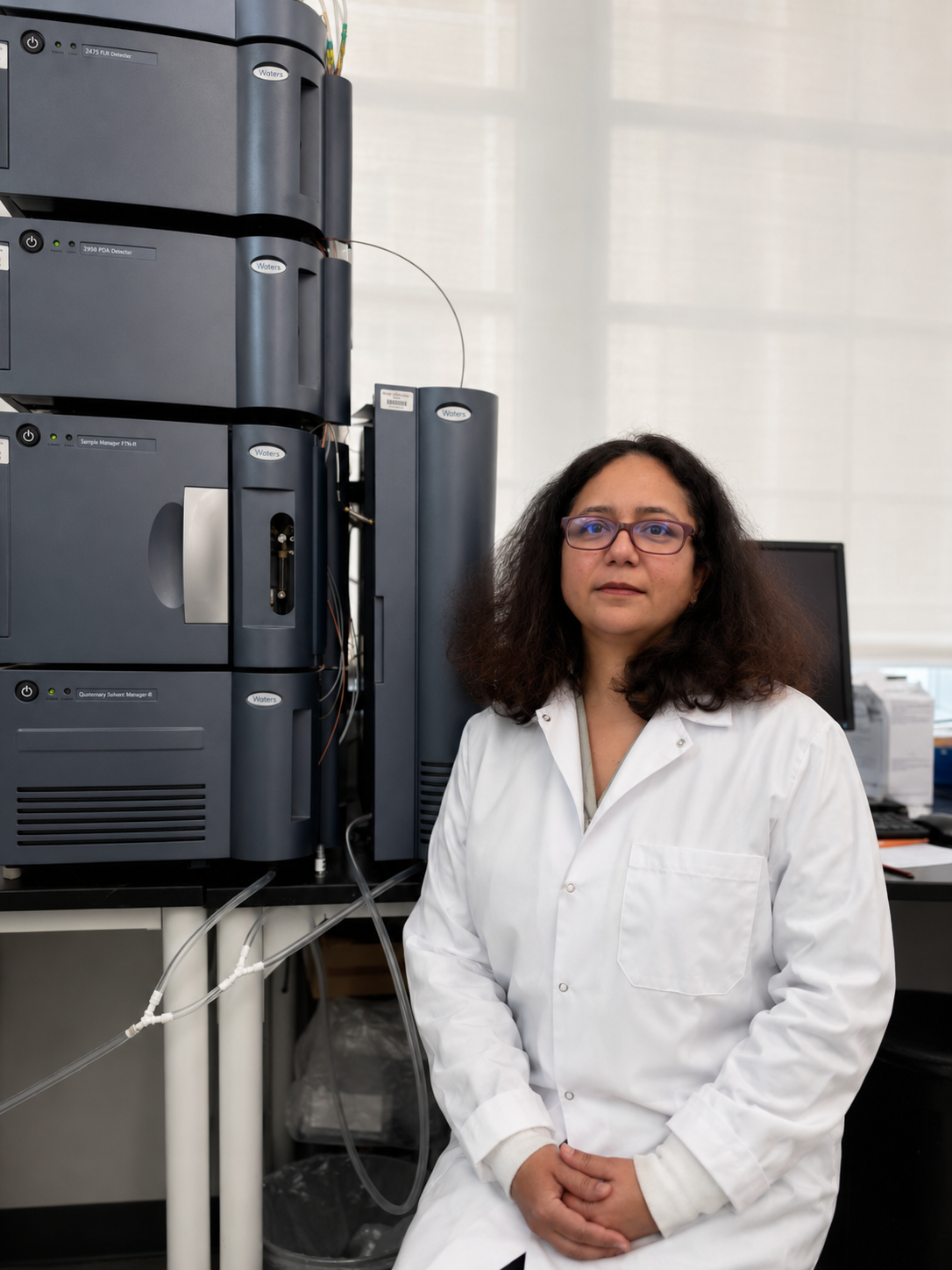
What inspired Sharma to spend her life’s work on precision drug development? She witnessed the profound impact of untreatable conditions on her own family growing up in India, and that drew her into drug development. Her older sister is severely autistic, and as a child, her parents explained to her that there was no cure for her sister. “I grew up thinking that I had to make medicines that could cure diseases. That was my motivation and is my mission.”
She earned a master’s degree in pharmaceutical chemistry and worked in the industry in India but realized she needed a PhD to conduct cutting-edge research that would solve such complex problems. While earning her doctorate in materials chemistry at McGill University in Montréal, she was introduced to dendrimer nanomedicine and later got the opportunity to contribute to early clinical development of dendrimer-based products for brain diseases at Johns Hopkins Center for Nanomedicine.
That’s how she got motivated to expand these nanoplatforms from brain diseases to all kinds of unmet needs.
She notes that dendrimers have deep roots in Michigan. Poly (amidoamine) (PAMAM) dendrimers were first conceptualized and synthesized by Donald A. Tomalia at Dow Chemical Company, making Michigan widely recognized as the birthplace of dendrimer science. For Sharma, the move to the University of Michigan represents both a scientific and symbolic homecoming for the field. “In many ways, it feels like bringing dendrimers back home to Michigan,” she said. “At the same time, our lab is advancing entirely new classes of dendrimer-based nanomedicines that move far beyond traditional architectures.”
Sharma collaborates with clinical researchers to test, refine, and translate those technologies into patient care. That’s what drew her to the University of Michigan after four years at Washington State University. She is eager to dive into the endless clinical and cross-disciplinary collaboration opportunities available at the College of Pharmacy.
“What really excites me about Michigan is the presence of infrastructure for taking drug technologies from the lab bench to the patient’s bedside,” she says. “Plus, all the potential collaborations — you name an expert, they are at Michigan.”
________________
About the College
The University of Michigan College of Pharmacy has been leading at pharmacy’s edge for 150 years. The first and oldest pharmacy school at a state university, the College — currently ranked #3 in the nation — has and continues to shape education in the field. Its faculty are internationally recognized and are innovators in drug discovery, development and delivery, precision pharmacotherapy, outcomes research, and clinical practice. More than 5,000 alumni are enhancing patient care and outcomes from the bench to the bedside, in boardrooms and communities, government agencies, and within healthcare companies.
Latest News
University of Michigan Celebrates Grand Opening of New College of Pharmacy Building, Advancing the Future of Healthcare Education
August 28, 2026
Media Contact: Kylie Rydjord, Contact and Marketing Communications Manager, [email protected]
ANN ARBOR, Mich. — As part of its 150th anniversary celebration, the University of Michigan College of Pharmacy today celebrated the grand opening of its new six-floor, 142,000-square-foot building. A state-of-the-art facility designed to transform pharmacy education, research and collaboration for generations to come.
Nearly 700 alumni, […]
InterActions: A Lasting Reflection of Michigan Pharmacy
August 18, 2026
When the University of Michigan College of Pharmacy began designing its new home, every detail was considered with purpose — from innovative research spaces to collaborative areas where students, faculty, alumni and visitors could connect.
The building itself was envisioned as more than a place to learn and discover. It would also tell the story of […]
Ashley Kuzmik: Bridging the Gap Between Hospital and Home
August 10, 2026
For many families, the transition from hospital to home after a loved one with dementia is discharged can be overwhelming. New medications, changing symptoms, mobility challenges and the demands of caregiving often converge all at once, leaving families to navigate an already difficult journey. Helping make that transition easier is at the heart of Ashley […]