
Answering the Call to Save a Life
May 11, 2026
More than two decades ago, a pharmacy student paused on his way to class when he saw a table set up outside a lecture hall with volunteers asking students to join the bone marrow donor registry. It was quick. It was easy. And to 18-year-old Daniel Hertz, it felt like a small but meaningful way to help someone in need.
So he signed up and didn’t think much about it again. 25 years later, his phone rang. On the other end was a representative from NMDP with unexpected news: Dr. Hertz was a match for a patient battling cancer and in need of a stem cell transplant.
A Rare Opportunity to Help In a Direct Way
For Dr. Hertz, now a faculty member and researcher, the opportunity to donate represents something deeply personal. While his pharmacy research aims to improve patient care on a broad scale, he rarely sees a direct connection to an individual patient.
“Most of us go into pharmacy to help people,” he said. “But as a researcher, I don’t always get to see that impact firsthand. This is a chance to know that I’m helping a specific person in a moment where they truly need it.”
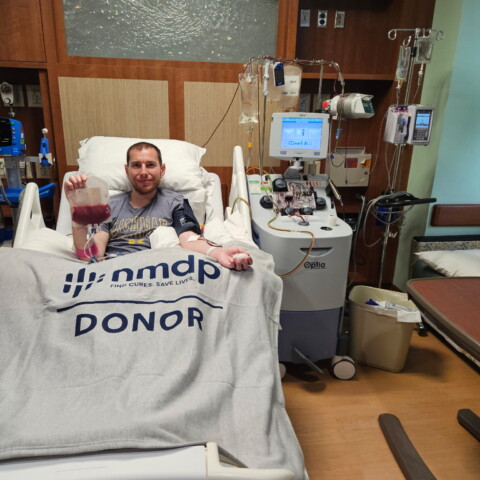 Finding a match is incredibly rare, often described as a one-in-a-million occurrence. Registries include millions of potential donors, but compatibility depends on a complex set of genetic markers. For many patients, especially those of Asian, Black, Hispanic or multi-ethnic backgrounds, finding a match can be even more difficult.
That’s what makes Dr. Hertz’s call so significant, not just for him, but for the anonymous patient on the other side.
What the Donation Process Looks Like
In the weeks leading up to the donation, Hertz has undergone a series of health screenings to ensure the process is safe for both him and the recipient. The next step involves injections that stimulate the body to produce additional blood-forming stem cells, which are then collected through a process similar to plasma or platelet donation.
While the science behind it is complex, the experience itself is relatively straightforward for donors. “My understanding is that I might feel sore for a couple of days,” Hertz said. “But beyond that, it’s not a major physical burden.”
For the recipient, however, the impact can be life-changing. “When a patient reaches the point of needing a transplant, this may be their last, best option,” he said. “This is something they truly need.”
A Personal Connection to Hope
Dr. Hertz’s decision to join the registry years ago may have been simple, but it was not without deeper meaning. When he was young, his mother was diagnosed with breast cancer and underwent treatment that included a stem cell transplant as part of a clinical trial.
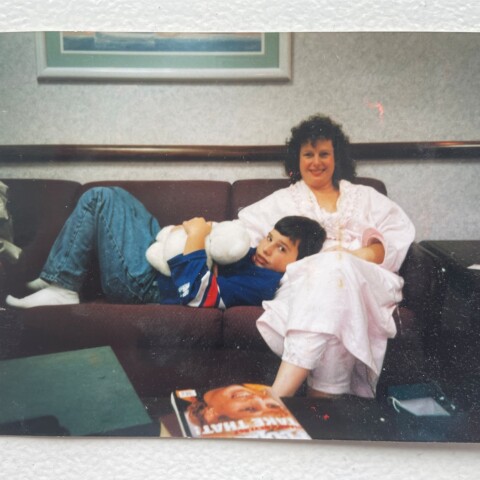
While that approach ultimately proved ineffective for her condition, it represented something powerful at the time for his family: hope. “I remember how hopeful my family felt,” said Hertz. “That stayed with me — if I were ever in a position to offer that kind of hope to someone else, I would.”
Now, decades later, he has that chance.
Full Circle Moment
There’s a certain irony in how this story came together. Just two years ago, Hertz tried to rejoin the registry after assuming his original registration had been lost to time. He later found out that NMDP keeps members on the registry through the age of 61. However, the age to join the registry is now limited to 18-to 35-year-olds, based on doctors requesting donors under the age of 30 the majority of the time.
“I was actually pretty disappointed thinking my time would never come,” he said.
So when he received a phone call a few months ago, he certainly didn’t expect it to be from the NMDP, or that the opportunity he thought had passed him by was suddenly back within reach.
Inspiring Others to Take the First Step
Dr. Hertz’s story is a powerful reminder that small decisions can have profound, long-term impact. A few minutes spent signing up as a college student has now become an opportunity to potentially save a life. Helping someone doesn’t always require a lifetime commitment.
The College of Pharmacy’s Community Health and Engagement hosts a yearly blood stem cell registry clinic to educate current students and community members about this very important need. Because sometimes it starts with a simple “yes,” a quick cheek swab and a phone call that, years later, changes everything.
McKesson Foundation Health Equity Speaker Series: Pharmacist Leadership for Population Health Improvement
October 15, 2026
McKesson Foundation Health Equity Speaker Series: Pharmacist Leadership for Population Health Improvement
Join Dr. Anand Parekh, Chief Health Policy Officer, School of Public Health and Senior Advisor, Institute for Healthcare Policy and Innovation, for this timely lecture on how health professionals can address social determinants of health. Dr. Parekh will focus on America’s suboptimal health outcomes, […]
Leroy B. Townsend Seminar Series: Scott Barraza, Ph.D.
October 13, 2026
Leroy B. Townsend Seminar Series: Scott Barraza, Ph.D.
Department: Medicinal Chemistry
Speaker: Scott Barraza, Ph.D., PTC Therapeutics Inc.
Title: Tuning the Spliceosome with Small Molecule Splicing Modulators
Abstract: This presentation summarizes the development of sequence-specific small molecule modulators of pre-mRNA splicing, outlines key lessons driving discovery of next-generation modulators, and reveals new insights into the mechanism and structural origin […]
Shaomeng Wang Drug Discovery Distinguished Lecture Series: Brian Blagg, Ph.D.
October 13, 2026
Shaomeng Wang Drug Discovery Distinguished Lecture Series: Brian Blagg, Ph.D.
Department: Medicinal Chemistry
Speaker: Brian Blagg, Ph.D.
Title: Turning Problems into Opportunities via Small Molecule Design
Abstract: The Hsp90 protein folding machine is a powerful modulator of proteostasis. It’s role in the maturation of signaling proteins and mutant proteins is well-documented and supports tumor initiation, progression and metastasis. Such […]