
Genetic Testing is Key to Safer Chemotherapy
June 13, 2024
By: Toni Shears
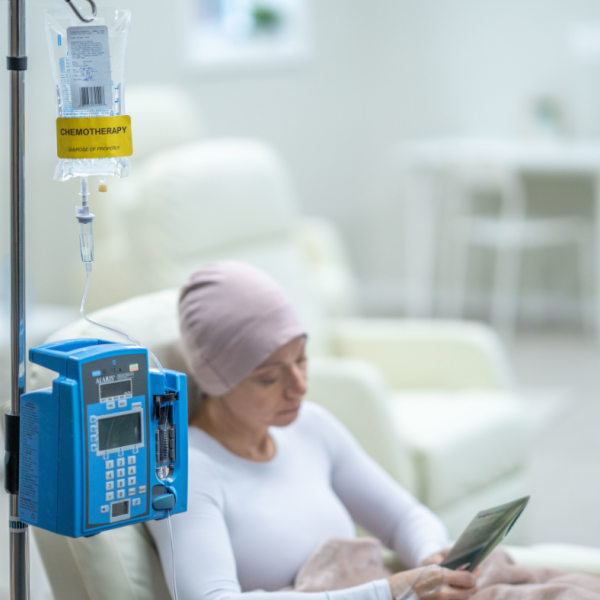 Some cancer patients carry a genetic variant that can lead to a dangerous, sometimes fatally toxic response to a common chemotherapy drug. It’s possible to test for the variants and plan a safer course of treatment for patients carrying the variant. Yet this is not the standard of cancer care in the U.S.
Daniel L. Hertz, PharmD, PhD, is working to change that. “We have known for several decades that patients carry a genetic variant that leads to a toxic response to chemotherapy,” says Hertz, associate professor of pharmacy. “We need to move towards testing patients and making sure those that carry a variant receive appropriate dosing.”
Oncologists treat colorectal, head and neck, and sometimes breast cancer with fluoropyrimidine (FP) based chemotherapies, which include 5-fluorouracil (5-FU) in intravenous form and capecitabine taken orally. A gene called DPYD produces an enzyme that removes these drugs from the body. Those who carry one of several DPYD variants metabolize these drugs more slowly; they face a 60% to 70% chance of experiencing severe toxicity to standard treatment.
Only about 6% of the population carries one of these variants, but the impact is serious; of those, about 30% will require hospitalization for the toxic response; 2% to 3% will die. Precise mortality estimates are hard to pin down, Hertz says, but the best data available from the Food and Drug Administration (FDA) and other sources suggest that about 1,000 patients a year die from this toxic reaction. “If patients are tested and turn out to be a carrier, clinicians can reduce the dosage. That cuts the chance of toxicity to about 30%, which is standard for the general patient population,” Hertz says.
Fighting for Change
Medications don’t always work the same way for everyone. The growing availability of genetic databases and powerful data analysis technology has made it possible to pinpoint genetic differences in how individuals respond to or break down drugs in the body and tailor treatment accordingly. This approach, known as pharmacogenomics (PGx), is driving personalized precision medicine. Unfortunately, it has been slow to enter mainstream practice, Hertz says. “If there’s a law, or a Food and Drug Administration regulation or clinical guideline —that will change practice,” he notes. “Otherwise, we have to convince one clinician at a time, one patient at a time, and that is a long, slow process.”
In Europe, genetic testing is the standard of care for patients who are candidates for FP therapies. Hertz is pushing for the US to follow suit. He co-authored a paper urging the U.S. Food and Drug Administration to recommend DPYD testing before patients receive fluoropyrimidine treatment. He has petitioned the FDA and the National Comprehensive Cancer Network (NCCN)to incorporate testing recommendations in treatment guidelines for this class of drugs.
For the past four years, Hertz has served as an unpaid medical adviser to an advocacy group founded by surviving family members who watched a loved one suffer and die from severe toxicity. The group, Advocates for Universal DPD/DPYD Testing, maintains that lives can be saved annually with a test that costs about $200.
Most Recent Stories
Think Pharmacy Is Just for People? Think Again.
October 8, 2026
When Maddie Pislin first came to the University of Michigan College of Pharmacy, she knew she wanted to be a pharmacist. She just didn’t know yet what that could look like.
Growing up in Hawaii surrounded by dogs, chickens, a turtle and other pets, Maddie had considered becoming a veterinarian. But veterinary pharmacy wasn’t on her […]
Pharmacists Are Like Superheroes: Who is a Pharmacist?
September 23, 2026
Who Is A Pharmacist?
When you think “pharmacist,” you probably picture someone in a white coat, handing you a bag of medicine across the counter and asking if you have any questions about your prescription. We are so lucky to have access to these health care providers on a regular basis, especially after hours when our […]
Jennifer Hagopian on Curiosity, Mentorship and Transplant Pharmacy
August 19, 2026
When Jennifer (Jen) Hagopian, PharmD, BCPS, BCTXP, selected a solid organ transplant APPE as a pharmacy student, she wasn’t planning her future career. She simply wanted to explore an area she didn’t know much about. That one rotation changed everything.
“I just tried to pick things that I didn’t really know too much about,” Dr. Hagopian […]